


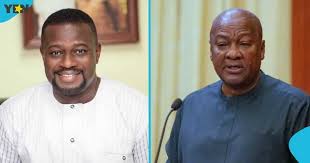

The Minority Chief Whip and Member of Parliament for Nsawam Adoagyiri, Frank Annoh-Dompreh, has called on President John Dramani Mahama to urgently intervene in what he describes as a worsening energy sector crisis threatening businesses and livelihoods across the country.
In an open letter addressed to the President, the New Patriotic Party legislator warned that the resurgence of persistent power outages, popularly known as “dumsor,” had exposed deep-rooted structural problems within Ghana’s energy sector.
According to Mr. Annoh-Dompreh, despite repeated assurances that the era of erratic power supply had ended, businesses and households continue to experience frequent outages, resulting in severe economic losses.
He stated that cold store operators, restaurants, salons and small-scale manufacturers were among businesses struggling to survive due to unreliable electricity supply.
“A fishmonger in Tema who invests GHS10,000 in stock can lose everything in a single unannounced 18-hour outage,” portions of the letter stated.
The Minority Chief Whip also criticised government over the introduction of the GHS1 fuel levy, arguing that the levy had been justified as a measure to stabilise electricity supply and reduce fuel prices, yet the country continues to face worsening outages and rising fuel costs.
According to him, diesel prices have increased from about GHS14.20 per litre to GHS16.20, while petrol prices have risen from approximately GHS11.40 to over GHS13.20 per litre.
He argued that many businesses could no longer operate continuously because of unstable electricity supply and the rising cost of powering generators.
“This is not governance, it is a contradiction,” he stressed.
Mr. Annoh-Dompreh further contended that Ghana’s current power challenges could no longer be blamed solely on generation deficits, noting that the country’s installed electricity generation capacity had improved significantly over the years.
He explained that installed capacity had increased from 3,774.6 megawatts to about 5,507 megawatts, while the country’s energy mix had expanded through thermal and renewable generation.
Despite these gains, he said Ghana continues to experience erratic power supply, which he described as evidence of unresolved policy and structural failures.
“Dumsor is not just a technical fault, it is a policy failure that is bleeding jobs and hope,” he stated.
The lawmaker subsequently proposed a series of reforms aimed at restoring stability within the sector.
Among the proposals was the merger of the Electricity Company of Ghana and the Northern Electricity Distribution Company to create a single distribution company capable of supporting effective private sector participation.
He also called for the merger of the Bui Power Authority and the Volta River Authority to reduce duplication and operational waste.
The Member of Parliament further proposed that the Ghana Grid Company should focus solely on transmission responsibilities, while an Independent Power Market Administrator should be established to coordinate planning and technical operations across the power value chain.
Mr. Annoh-Dompreh also urged President Mahama to suspend the GHS1 fuel levy, publish a financial audit of the energy sector and disclose the true state of Ghana’s electricity generation capacity.
Additionally, he called for the establishment of an Emergency Energy Sector Task Force comprising parliamentarians, civil society organisations and independent experts to develop a credible recovery plan for the sector.
He further appealed to government to engage Independent Power Producers and gas suppliers to resolve outstanding payment arrears threatening electricity generation.
Beyond the immediate outages, the Minority Chief Whip raised concerns about the mounting debt burden within the energy sector, warning that unpaid obligations to Independent Power Producers could eventually cripple generation capacity.
He also criticised what he described as unfavourable take-or-pay agreements that continue to drain public resources.
According to him, weak coordination among sector institutions, including the Public Utilities Regulatory Commission, ECG, GRIDCo and VRA, had contributed significantly to the recurring instability in the power sector.
The open letter also touched on the plight of cocoa farmers, food security concerns and alleged administrative irregularities at the Environmental Protection Agency.
However, the worsening power crisis dominated the appeal, with Mr. Annoh-Dompreh insisting that urgent executive action was necessary to restore confidence in the energy sector and protect Ghana’s economy.