


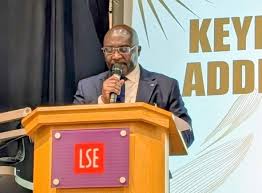
, Dr Mahamudu Bawumia, has outlined six key policy commitments he believes are essential for Africa to emerge as a global force in artificial intelligence (AI).)
Former Vice President of Ghana and 2028 flagbearer of the New Patriotic Party (NPP), Dr Mahamudu Bawumia, has outlined six key policy commitments he believes are essential for Africa to emerge as a global force in artificial intelligence (AI).
Delivering a keynote address at the 2026 LSE Africa Summit held at the London School of Economics and Political Science, Dr Bawumia urged African leaders to shift from rhetoric to action in building a competitive and sustainable AI ecosystem across the continent.
He emphasised that Africa’s success in the digital age would depend on deliberate planning, sustained investment, and the strengthening of institutional capacity.
“Technological revolutions reward those who build foundations: institutions, infrastructure, skills, and rules before they chase the latest applications,” he stated. “Africa must act boldly, but methodically, to secure its place in the global digital economy.”
Dr Bawumia’s proposals centred on six core areas designed to lay a strong foundation for AI development in Africa.
He called for significant investment in reliable electricity and broadband infrastructure, noting that digital transformation cannot occur without stable power and widespread internet access. He also stressed the importance of building secure and scalable data systems to support innovation.
Another key focus was the development of trustworthy data ecosystems, which he said are critical for training AI systems and ensuring public confidence in emerging technologies.
Dr Bawumia further highlighted the need for large-scale talent development programmes, arguing that Africa must invest heavily in education and skills training to produce a workforce capable of driving AI innovation.
He also pointed to the importance of strengthening public sector procurement capacity, enabling governments to effectively adopt and scale AI solutions. In addition, he underscored the need to integrate ethical standards into AI deployment, ensuring that technological advancements align with societal values.
Beyond national strategies, Dr Bawumia advocated for deeper cross-border collaboration among African countries. He noted that interoperable digital markets would be crucial in unlocking the continent’s full potential in AI.
“Build AI foundations, build trustworthy data ecosystems, build talent at scale,” he reiterated, stressing that coordinated efforts would accelerate progress and enhance competitiveness.
Dr Bawumia concluded his address with a strong call to action, urging African governments, institutions, and private sector actors to seize the current opportunity to shape the future of artificial intelligence.
“Africa should be poised to shape the global AI conversation not as a passive consumer, but as a builder of responsible systems,” he said. “If we unite borders through infrastructure, skills, governance, and markets, then AI can become a force for shared prosperity.”