



BY: Mohammed Mutala, Political Communication Strategist
In politics, as in branding, there is a world of difference between a “product” that simply creates noise and one that builds lasting market share.
As the New Patriotic Party (NPP) approaches its January 31 presidential primaries, the air is thick with the populist energy of Kennedy “Akumpreko” Agyapong and the institutional weight of Dr. Mahamudu Bawumia.
However, if the party’s goal is not just to survive this primary but to reclaim the Jubilee House in 2028, the decision must move beyond raw emotion. From a strategic branding perspective, this contest represents a choice: do we want a “Power Surge” that risks volatility, or a “Steady Bridge” designed for long-term growth?
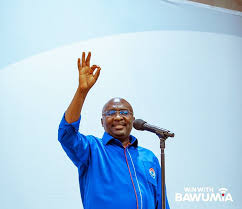
While grassroots fire is essential to keep the base alive, it is Dr. Bawumia’s dual brand identity—the bridge to the North and Zangos, and as the face of Ghana’s digital transformation—that offers the NPP its most credible path to victory. His unique blend of relatability and modernity appeals to both the grassroots and the technocratic middle class, uniting two audiences the party has often struggled to hold together.
Victory in 2028 for the NPP won’t depend on winning any single region outright; it will depend on improving margins everywhere across the country. Dr. Bawumia, as candidate, gives the party that balance—a steady appreciation in the North and Zangos to complement strength in the South and urban centers.
The Zango Evolution
To understand why Dr. Bawumia is the party’s most viable bridge to the Zangos and the five regions of the North, we must look past the raw numbers of 2024 and focus on the journey—where the NPP came from, in terms of political dynamics in those once-difficulty terrains, and where it stands today.
The NPP’s challenge, particularly in the Zango communities, has never been a lack of policy; it has been a lack of cultural relatability. In the Zangos, politics is personal.
For decades, the political map of Ghana was etched in stone: the Zangos and Northern regions were considered the “World Bank” of the NDC. To many, the NPP was a product they simply weren’t buying. However, as a Brand Architect who has spent years chronicling the untold stories of these communities through Zango Spotlight, I have witnessed a subtle but seismic shift in brand perception.
In the 90s and early 2000s, it was culturally—and almost socially—forbidden for a Zango native to openly associate with the NPP. Back then, identifying as an “Elephant” was a secret kept behind closed doors for fear of being outcast by one’s own community.
Today, that “shame” has been dismantled. Since 2008, the NPP’s performance in these enclaves has seen a steady, marginal climb. The party is now a respected brand in Zangos across the country. While it would be an exaggeration to say Dr. Bawumia has completely broken the NDC’s hold, there is no denying that his personality has contributed materially to normalizing the party’s presence in these enclaves.
Before his emergence, I personally witnessed the kind of unprintable things Zango people, led by the NDC, used to say about the NPP during election campaigns. Dr. Bawumia’s rise in our politics has, to a large extent, changed that tone. In Zango, today, while the majority still identify with the NDC, the attacks on the NPP is not as before. They may not have voted for him yet, but the simple fact that they see him as “one of us” offers a hope-inspiring foundation for future campaigns.
And that is the strategic point: the NPP does not need to win the Zango and Northern votes en bloc, to win the presidency. What it needs is steady appreciation—a 5 to 10% improvement that, when combined with strong southern and urban numbers, closes the national gap. In the 2016 electioneering, this was exactly what happened in those areas. A matter of fact: the results had Dr. Bawumia’s fingerprints all over them. His brand is the only tested bridge capable of delivering that again.
The “Rescue Mission” of 2024
It is, frankly, quite simplistic and convenient for associates of other contenders, particularly those of Kennedy Agyapong and Dr. Bryan Acheampong, to weaponize the 2024 results, especially in the Zangos, against Dr. Bawumia.
Those claims smack of a poor understanding of what actually happened on the ground, both in the North and the Zangos.
In 2024, the NPP wasn’t just fighting the NDC; the party was confronting a national protest vote and the fatigue of an eight-year incumbency. Dr. Bawumia wasn’t a failed candidate; he was a leader who stepped up in an exceptionally difficult storm.
In the Zangos, where the NDC’s roots run deep, Dr. Bawumia led what I call a strategic rescue mission. Without his face on the ticket, the NPP might have faced a far more embarrassing outcome—a wipeout that would have taken decades to recover from.
He held the line when the party was on the brink. Those who view 2024 as a weakness miss the point: in the Zango community, holding your ground during a protest is the ultimate sign that your brand has become unbreakable.
Flipping the Zango votes, for now, is too ambitious and unrealistic. What the NPP should aim for in those communities, in the interim, is to consolidate the gains of steady incremental growth. Dr. Bawumia, as flagbearer, is the key to achieving that goal.
The Master Architect
The NPP does not need to start from zero in 2028; the party must build on the foundation of visibility that has taken nearly twenty years to construct.
Dr. Bawumia has the lived experience to understand the peculiar needs of the Zangos, the five regions of the North, the technocratic middle class, and the digital-first youth across Ghana—all at once.
He represents something no other contender can: a bridge between identity and innovation, tradition and transformation. His politics speaks the language of inclusion, progress, and purpose—a brand of leadership the next decade demands.
Politics is a long game. The claim that Bawumia is “electorally spent” is a dangerous misreading of the national pulse.
To punish the man who finally made the NPP acceptable in the Zangos and the North—and who continues to expand the party’s appeal among the youth and middle class nationwide—is to surrender the very advantage we need to win the next election.
As delegates head to the polls on January 31, they must ask themselves one question:
Do we want a megaphone—or do we want a bridge?
The delegates hold the keys. They can choose a candidate who promises fire but risks burning the bridges we desperately need to cross—or they can choose the master architect who kept the light on during the storm.
The logic is simple: protect the bridge that kept you standing, or risk falling into an abyss.
Let’s #WinWithBawumia.
Author Bio:
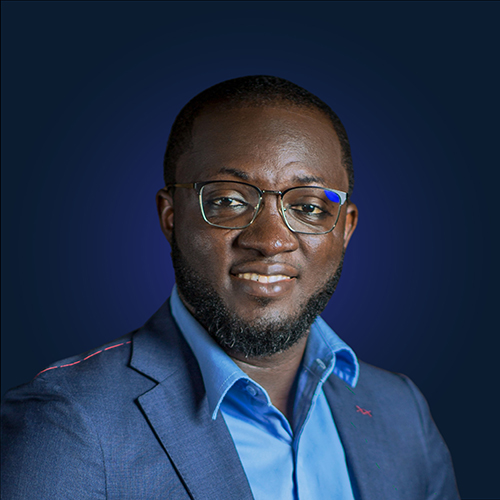
Mohammed Muntala is a Brand Architect, political communications strategist, and co-founder of Zango Spotlight—a storytelling platform dedicated to reshaping narratives about underrepresented communities. He works with public figures and leaders on brand strategy, executive communications, and digital reputation management.