


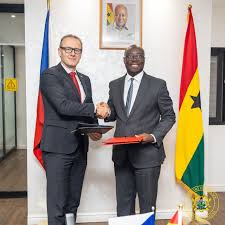

Ghana has signed its seventh bilateral debt restructuring agreement, this time with the Czech Republic, marking another significant milestone in the country’s ongoing efforts to restore debt sustainability and strengthen international financial cooperation.
The agreement was signed by the Minister for Finance, Dr. Cassiel Ato Forson, and Mr. René Jakl, Director of the Claims and Recoveries Department at the Export Guarantee and Insurance Corporation (EGAP), who represented the Czech Republic.
Speaking at the signing ceremony, Ato Forson expressed Ghana’s appreciation to the Czech government and its people for their continued support, noting that the agreement reflects the strong and enduring relationship between the two countries.
“This agreement is a testament to the deepening ties between Ghana and the Czech Republic and our shared commitment to mutually beneficial cooperation,” the Finance Minister said.
Mr. Jakl, on his part, described the agreement as the start of a new chapter in bilateral relations, stressing that it opens the door for enhanced collaboration and additional support in the future.
The ceremony was witnessed by the Czech Republic’s Ambassador to Ghana, Mr. Pavel Bílek, as well as senior officials from Ghana’s Ministry of Finance.
The Czech Republic deal follows earlier bilateral debt restructuring agreements concluded with China, Finland, and the United Kingdom, bringing Ghana closer to completing the external component of its comprehensive debt restructuring programme. Additional agreements have also been signed with France, Spain, and Germany, bringing the total number of participating bilateral creditor countries to seven.
The International Monetary Fund (IMF) has described these agreements as a major step forward in Ghana’s efforts to restore debt sustainability and rebuild investor confidence after several years of fiscal strain.
With the external debt restructuring gaining momentum, Ghana’s debt outlook has improved, supported by a stronger macroeconomic forecast and ongoing fiscal consolidation measures. Analysts expect the successful execution of the bilateral agreements to ease external financing pressures, help stabilize the cedi, and support a more robust economic recovery in 2026.
The progress is also expected to keep Ghana on track to meet key targets under its IMF-supported programme, strengthening prospects for a successful exit from the programme as planned.